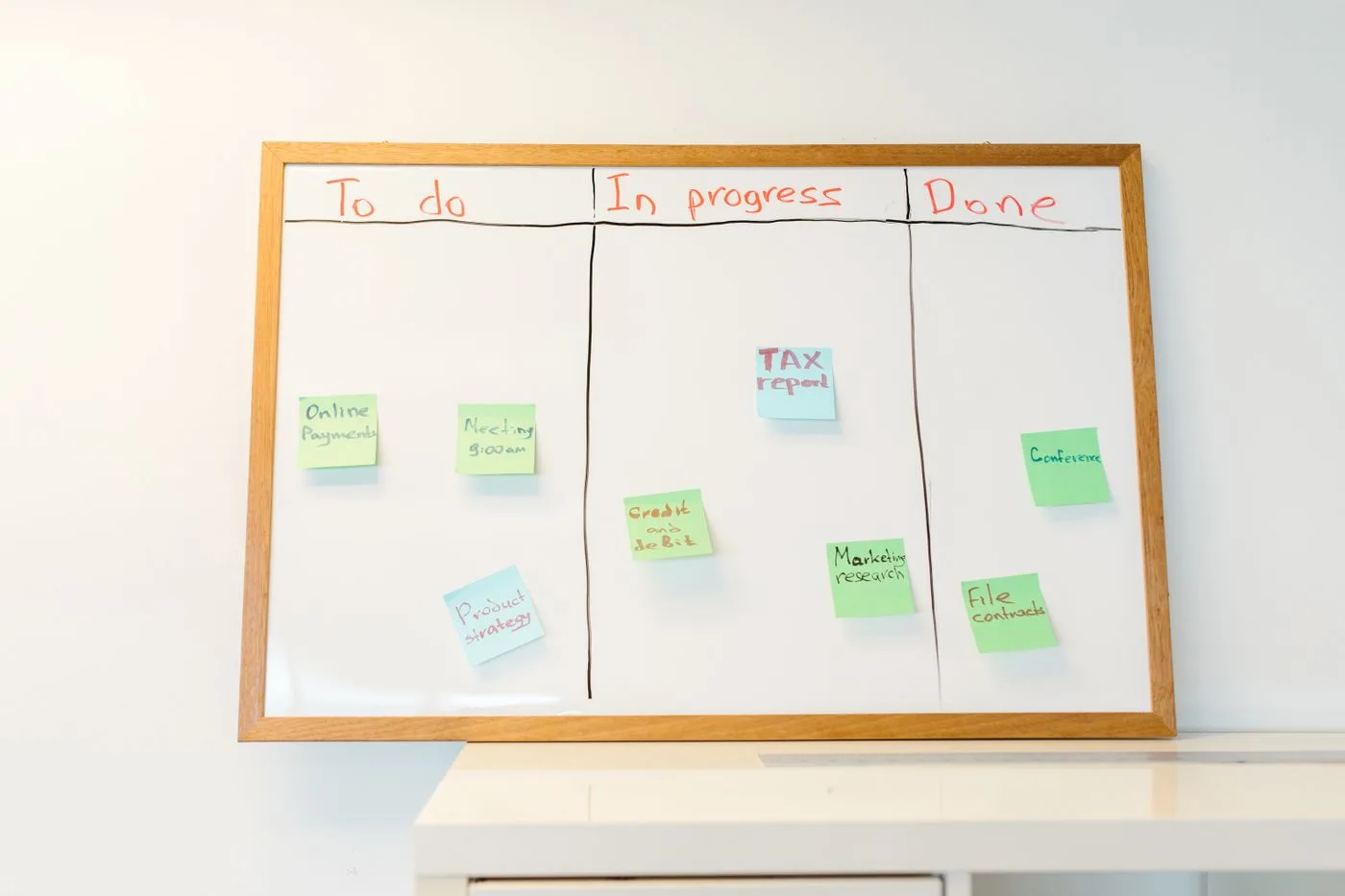
A task card should describe work that someone can finish. “Social media” is too broad. “Select three approved images for the workshop post” identifies an outcome. This distinction makes a simple task board useful whether it consists of sticky notes or software.
Begin with a few columns: planned, in progress, awaiting a response and complete. Briefly define when a card moves between them. A finished draft is not published if approval is still outstanding.
Give each card a visible finish
Include an owner, required materials and a clear completion condition. For a landing page, that might mean approved copy, a tested contact link and a check of the published page on a phone. Completion conditions should fit the task; they do not need to be identical for every card.
Add a date when it supports a real coordination need. Inventing deadlines for every minor task creates overdue cards without necessarily improving planning. Firm publication dates, however, should be clearly visible.
Start fewer things at once
If everything is marked “in progress”, the board no longer communicates priorities. Agree on a small amount of simultaneous work that fits the available capacity. Before starting another task, check whether current work can be finished or an obstacle removed.
A waiting card needs a reason and a next owner. “Waiting” alone can remain unchanged for weeks. “Waiting for the product photograph from Jana; check on Thursday” describes a state that can be managed. Include only information appropriate for the people who can see the board.
When an urgent request arrives, show what it displaces. Quietly adding it to everyone's existing workload hides the effect on other commitments. A visible trade-off helps the business decide which outcome matters most.
Maintain the board
Review open cards in a short recurring session. Remove or archive tasks whose purpose has disappeared. Split work that has become too large to finish clearly. Completed items can support a retrospective, but they should not overwhelm the current view.
The board is not a measure of personal productivity. Ten small cards are not necessarily more valuable than one difficult completed task. Use it to understand responsibilities and bottlenecks rather than to compare people by the number of cards they move.